
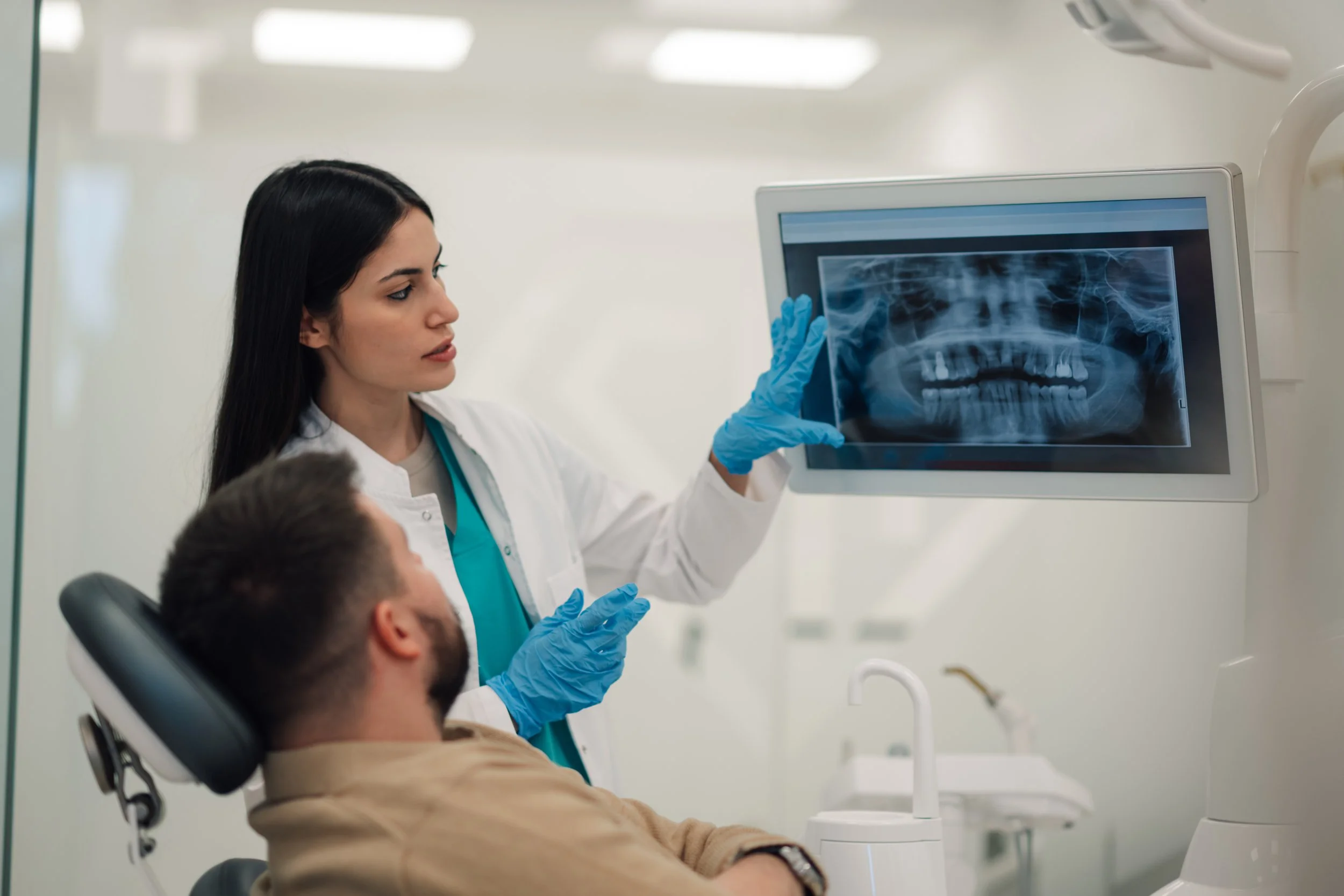
Trusted 3D Xray Dentist in Mountain View for Advanced Dental Care
Choosing a 3D X-ray dentist in Mountain View means choosing a higher level of accuracy, safety, and confidence in your dental care.
At Mountain View Family Dental, we use advanced 3D imaging technology to diagnose conditions more precisely, plan treatments more effectively, and deliver care that is tailored to each patient’s unique needs. 3D dental scans emit less radiation than traditional imaging methods, such as full-mouth film X-rays, making them a safer choice for our patients.
What Is 3D Dental X-Ray Technology?
3D dental X-rays—also known as cone beam computed tomography (CBCT) —are captured using a cone beam CT scanner that creates detailed three-dimensional images of the teeth, jawbone, nerves, and surrounding structures.
3D dental X-rays allow dentists to clearly visualize teeth, jawbone, nerves, sinuses, and the nasal cavity, supporting more accurate diagnosis and treatment planning. 3D imaging gives dentists a comprehensive view of the patient’s oral anatomy, allowing for more accurate diagnosis and treatment planning.
Unlike traditional X-rays that capture limited areas, 3D dental imaging provides a complete view of the entire mouth, including teeth, bone, nerves, and surrounding structures.
This technology allows dentists to clearly visualize complex dental structures, including tooth roots, jawbone, nerves, and sinus cavities, all in a single 3D image.
Compared to traditional CT scans, dental CBCT scans emit significantly less radiation and are specifically focused on dental and maxillofacial anatomy, making them safer and more precise for dental diagnostics. nal clarity.
In addition to teeth and jawbone, 3D dental imaging allows dentists to evaluate surrounding facial structures, providing a more complete understanding of oral and facial anatomy.
As a trusted 3D X-ray dentist, Mountain View Family Dental uses this technology to:
- Identify dental issues that may not appear on standard X-rays
- Measure bone density and volume
- Locate nerves and sinus cavities accurately
- Detect infections, fractures, and abnormalities early
3D dental imaging can also visualize soft tissues in the mouth, aiding in the diagnosis of conditions affecting the gums and palate. This level of detail allows for more informed decisions and improved treatment outcomes.
Why Choosing a 3D X-Ray Dentist Matters
Selecting a 3D X-ray dentist ensures your care is guided by precise diagnostic information. Your dental provider plays a crucial role in ensuring patient care and safety by utilizing advanced technology to deliver accurate diagnoses and effective treatment plans.
Many modern dental offices now rely on 3D imaging to improve diagnostic accuracy, enhance patient safety, and deliver more predictable treatment outcomes.
Advancements in the dental industry, such as 3D imaging, are transforming the standard of care and improving patient outcomes.
Advancements like 3D imaging are now becoming the standard in modern dental practices, helping providers deliver safer, more accurate, and more predictable care.
Greater Diagnostic Accuracy
3D X-rays provide highly detailed and more accurate images than traditional X-rays, helping dentists identify problems at earlier stages. This can prevent minor issues from becoming more complex and costly over time. This level of detail allows dentists to identify dental problems earlier, often before symptoms appear, helping patients avoid more complex treatment later.
Improved Treatment Planning
With a complete view of your oral anatomy, dentists can map out procedures step by step. 3D imaging is also valuable for orthodontic treatment, as it helps assess tooth and jaw alignment for braces and aligners.
Enhanced Patient Safety
Knowing exactly where nerves, roots, and anatomical structures are located reduces the risk of complications during treatment.
According to the American Dental Association, advanced imaging plays a vital role in accurate diagnosis and treatment planning in modern dentistry.
Technology Benefits of 3D Dental Imaging
One of the biggest advantages of visiting a 3D X-ray dentist is the ability to combine advanced technology with patient-focused care. CBCT imaging, the technology behind 3D dental scans, allows for highly accurate and efficient imaging compared to traditional methods.
These scans are essential for complex procedures that require a full view of the mouth, jaw, and nerves, and are used to assess the entire oral landscape with unprecedented precision.
Modern 3D dental imaging systems use a focused X-ray source that rotates around the head, capturing detailed images while minimizing radiation exposure.
Cone beam imaging is specifically designed to minimize radiation exposure while still producing highly detailed diagnostic images for accurate treatment planning.
Lower Radiation Exposure
Modern 3D X-ray systems are designed to minimize radiation while still producing highly detailed images. 3D dental scans use less radiation than traditional X-rays and significantly less than medical CT scans, making them a safer diagnostic tool for patients.
Faster, More Comfortable Imaging
3D scans are quick and non-invasive; the scanning process typically takes only a few minutes and involves minimal discomfort for the patient.
Clear Communication with Patients
Three-dimensional images allow dentists to visually explain conditions and treatment options. Patients can see exactly what is happening, which often leads to greater understanding and confidence.
3D X-Ray Dentist for Dental Implants and Oral Surgery
Dental implants and oral surgical procedures require precise planning. As an experienced 3D X-ray dentist, Mountain View Family Dental relies on 3D imaging to ensure implants are placed accurately and safely. Clear visualization of maxillofacial structures allows dentists to plan implant placement and oral surgery with greater precision and reduced risk.
3D X-rays help dentists:
- Measure available bone for implant placement
- Identify optimal implant positioning
- Avoid nerve damage and sinus complications
- Identify nerve pathways for precise treatment planning
- Improve long-term implant success rates
Advanced 3D imaging is especially valuable when planning dental implants and jaw surgeries, as it allows dentists to evaluate bone structure, nerve pathways, and anatomical risks in advance.
The Mayo Clinic highlights the importance of advanced imaging for improving surgical outcomes and reducing risks.
Improved Accuracy for Root Canals and Restorative Dentistry
Root canal therapy and restorative treatments benefit greatly from 3D imaging. A 3D X-ray dentist can identify complex root structures, hidden infections, or fractures that may not be visible on standard X-rays.
This improved accuracy helps:
- Reduce the likelihood of retreatment
- Improve long-term tooth preservation
- Minimize discomfort during procedures
- Assess tooth orientation and detect tooth decay for more effective diagnosis and treatment
3D dental imaging enhances the examination of internal tooth structures for root canal treatments.
Patient Safety and Predictable Outcomes
Patient safety is a top priority at Mountain View Family Dental. Using 3D imaging allows our team to approach treatment with greater confidence and preparation.
Fewer Surprises During Treatment
Because potential complications are identified ahead of time, treatments tend to proceed more smoothly and efficiently.
Better Long-Term Results
Accurate planning leads to treatments that are more durable and predictable, reducing the need for corrective procedures later.
The National Institute of Dental and Craniofacial Research emphasizes the importance of early diagnosis and precise treatment planning for long-term oral health.
How a 3D X-Ray Dentist Improves Long-Term Oral Health Outcomes
Working with a 3D X-ray dentist doesn’t just improve immediate treatment accuracy—it also plays an important role in protecting your long-term oral health. Advanced 3D imaging allows dentists to detect concerns earlier.
After the scan, the dentist will review the 3D images and discuss the findings with the patient.
Early Detection and Preventive Advantages
One of the key benefits of 3D dental imaging is the ability to identify issues that may not yet be causing symptoms. Hairline fractures, early bone loss, impacted teeth, and hidden infections can often go unnoticed on traditional X-rays.
Monitoring Changes Over Time
3D X-rays provide detailed baseline images that can be referenced during future visits. This helps dentists track subtle changes in bone density, tooth position, and oral structures.
Supporting Confident, Data-Driven Decisions
When treatment decisions are based on precise, three-dimensional information, patients benefit from greater predictability. A 3D X-ray dentist can recommend treatment options with confidence, knowing they are supported by detailed diagnostic data rather than assumptions.
A Smarter Investment in Your Dental Health
By supporting accurate diagnosis, safer procedures, and better long-term planning, a 3D X-ray dentist helps patients protect their investment in their smile.
At Mountain View Family Dental, our commitment to 3D imaging reflects our dedication to providing dental care that supports your oral health not just today—but for years to come.
A Personalized Approach with a 3D X-Ray Dentist
Every patient’s anatomy is different. A 3D X-ray dentist can tailor treatment plans based on your specific needs rather than relying on generalized assumptions. Oral surgeons also rely on 3D imaging for precise planning of complex procedures.
At Mountain View Family Dental, this personalized approach allows us to:
- Customize treatment timelines
- Choose the most conservative options possible
- Improve comfort and recovery
Patients appreciate knowing their care is based on precise information and thoughtful planning. The 3D dental imaging procedure is painless and requires no preparation beforehand.
Frequently Asked Questions About 3D Dental X-Rays
What is the difference between traditional X-rays and 3D X-rays?
Traditional imaging, such as traditional X-rays, uses small amounts of radiation to create two-dimensional images of the mouth. Traditional X-rays show flat images, while 3D X-rays provide detailed, three-dimensional views of teeth and bone structures.
Are 3D dental X-rays safe?
Yes. Modern 3D X-ray systems use low radiation levels and are considered safe for most patients. They are designed for lower radiation exposure, but traditional X-rays are still preferred for routine check-ups due to their lower radiation levels and cost.
When is a 3D X-ray necessary?
3D imaging is often used for dental implants, oral surgery, root canal evaluation, and complex restorative cases.
Does a 3D X-ray hurt?
No. The scan is quick, painless, and non-invasive. During the scan, the patient's head will be positioned and stabilized in the imaging machine, and they must remain still to obtain clear images.
Will my insurance cover 3D dental X-rays?
Coverage varies by plan. Our team can help review your benefits and answer questions.
Schedule an Appointment with a 3D X-Ray Dentist in Mountain View
Choosing a 3D X-ray dentist at Mountain View Family Dental means choosing precision, safety, and confidence in your dental care. With advanced imaging technology and a patient-first approach, we help ensure every treatment is planned with accuracy and delivered with care.
>Contact Mountain View Family Dental today to schedule your appointment and experience the difference a 3D X-ray dentist can make for your oral health.


